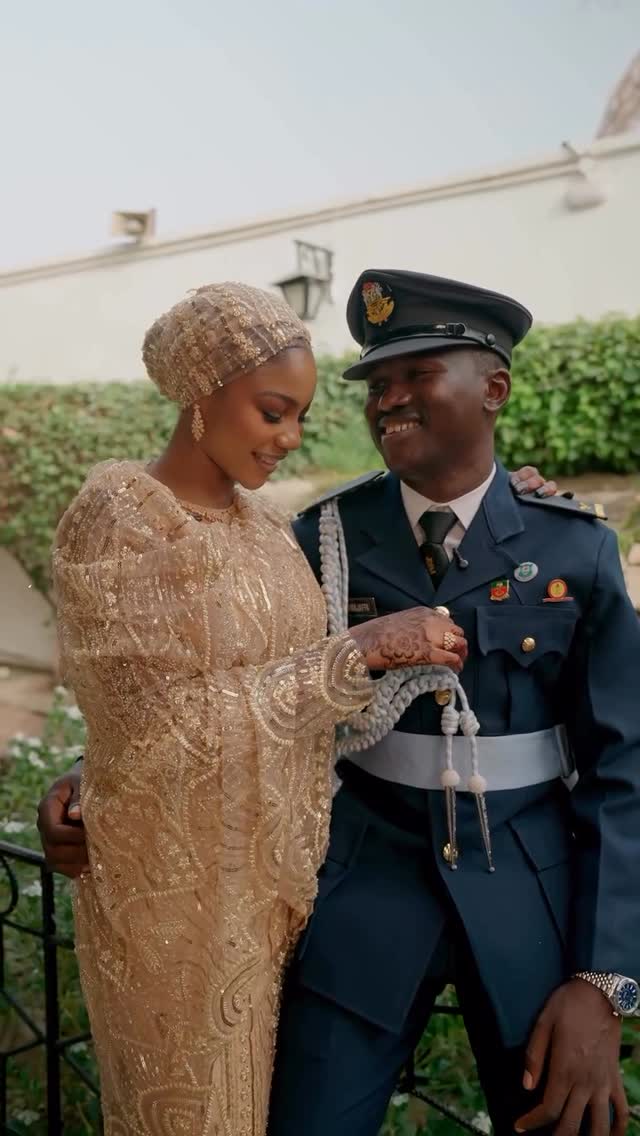
Read the captions of fifty Nigerian Christian wedding videos and a small linguistic pattern emerges. The English-language vow has, over the last decade, been compressed into a four-verb cadence. To love, to hold, to protect, forever. Sometimes the verbs change — to honour, to cherish, to keep — but the rhythm is invariant. Four beats. The final word almost always lands on forever.
The form has nothing to do with the Anglican Book of Common Prayer, which is what was originally being adapted in Nigerian Anglican ceremonies. The Prayer Book vow is a sprawling sentence that includes better, worse, richer, poorer, sickness, health — eight nouns of conditional commitment. The new four-verb vow strips that down to the active verbs alone, removing the conditions, replacing them with one durative adverb.
What's remarkable is that no church wrote this. It is not in any liturgy. It has emerged, instead, from the grammar of the wedding caption — the line a couple writes underneath their photo on Instagram, the line a videographer puts at the start of a reel. It is a vow form invented by the photographers and the brides themselves, then absorbed back into the ceremony, then said aloud by a pastor who, twenty years ago, would have asked everyone to repeat after him from a printed leaflet.
The new vow is shorter than the old one because love, in this generation, has fewer conditions and more verbs.
It would be tempting to read this as a flattening — a loss of the complexity of the older language. But there is a case for the other reading. The four-verb vow is more honest about what marriage actually is. It does not promise health or wealth, both of which are largely outside a couple's control. It promises only what is within their control: the quality of their continuing attention. To love. To hold. To protect.
And then forever, which is the part that is technically untrue and emotionally exact, the part that every wedding has always required, the part that the gele and the cake and the tear and the dancing father-in-law are all, in the end, defending. The vow has shrunk, but its centre is still its centre. The pastor pronounces. The room exhales. The four verbs become, at the moment of their saying, the only sentence the couple now has to live up to.