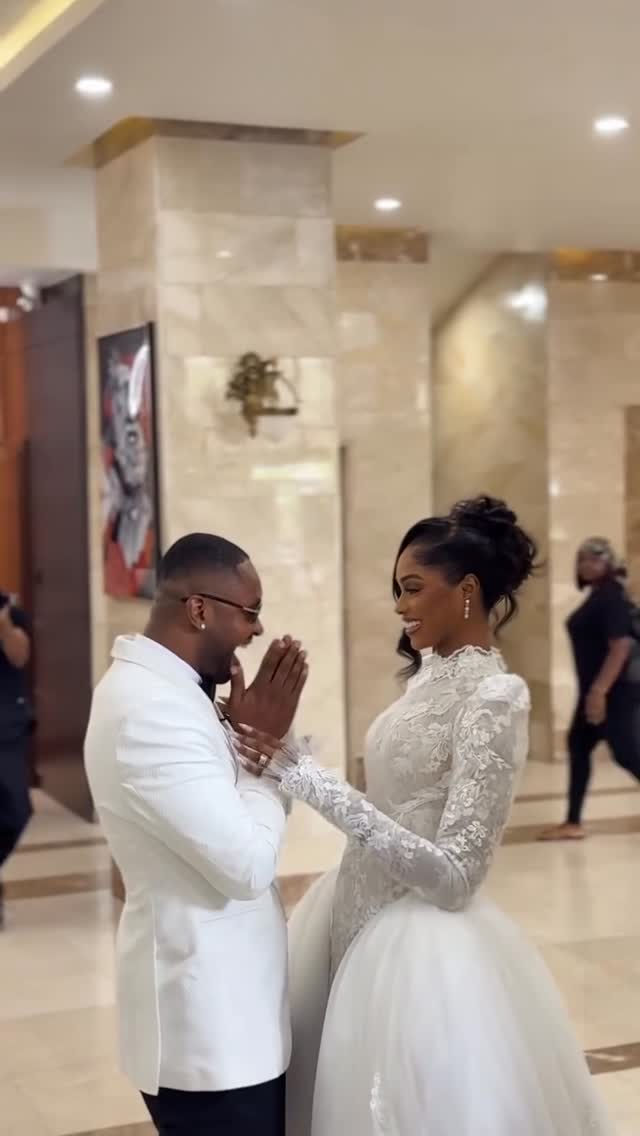
The first look is, technically speaking, a Western import. American couples have been doing it since at least the 2010s — a private, photographed moment in the hour before the ceremony, the groom turned away, the bride approaching, the reveal captured by a photographer who has positioned themselves at exactly the right angle. For decades the Nigerian wedding had no use for it. The bride processed in. The groom watched her arrive. The whole congregation watched along with him. The reveal was the wedding.
Then, somewhere in the last few years, Lagos couples — and Nigerian couples around their diaspora — quietly absorbed the first look into their own choreography. It was inevitable, perhaps. The professional wedding photography industry that had grown up around the country could not waste an entire morning of golden light. The bride's hair and makeup, finished by ten o'clock, would not survive a 2pm reception untouched if her dress was kept in the dark. The first look gave the photographer something to do, the bride something to hold onto, and the groom — this is the part the form most insists on — a moment to react before he was required to behave.
What's interesting is how the imported tradition adapted. In its American original, the first look is romantic, low-key, often outdoors, often near a body of water for reasons no one quite remembers. In the Nigerian version, the room is busier. The bride's mother is sometimes nearby. The photographer's assistant is fixing a wrinkle. There is a small bottle of water being passed around. The reveal is private only in the sense that it is not yet public — it is still witnessed by everyone whose job it is to be in that room. The groom turns. The bride is there. He covers his mouth, or his eyes, or both. He laughs the laugh of a man who has been holding his breath without meaning to.
The first look is the only moment of the wedding where they are alone enough to be themselves and accompanied enough to be remembered.
The form has produced a small genre of photograph that is now its own visual language. The bride mid-stride, dress trailing, hair caught by an unseen wind. The groom in three-quarter profile, hand at his temple, the light hitting his cuff link. Sometimes the bride's veil is lifted by a sister at exactly the moment of recognition. The cumulative effect — once you have looked at a few thousand of them on Instagram — is a sense that the first look is a particular kind of formal portrait, one in which both subjects have agreed in advance to be unprepared.
What the first look agrees to, in a Nigerian wedding context, is something specific. It is not the marriage — that comes later, in the church or before the elders. It is not the public moment — that comes when the doors open. It is the smaller agreement that precedes both. You will be the person I see today. I will be the person you see. The look is rehearsed and unrehearsed at the same time, the way most important agreements are. The bride has been getting ready since dawn. The groom has been pretending not to think about how she looks. They have agreed to meet, briefly, in the room before the room.
And then they go in.