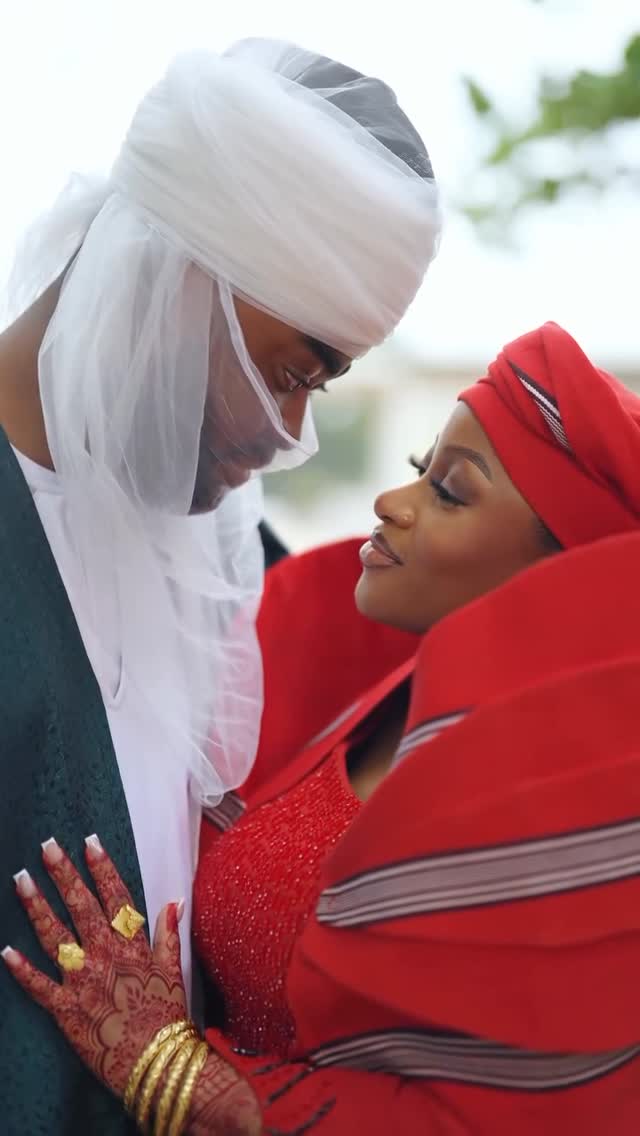
The Nigerian wedding is not one wedding. It is at least three, sorted geographically — Yoruba in the south-west, Igbo in the south-east, and the cluster of Northern traditions that includes Hausa, Fulani, Kanuri and others. The aesthetic of a Northern wedding does not move at the same speed as the southern ones. It is more sovereign, more palatial, more interested in the slow procession than the sprint.
The bride in a Northern Muslim wedding does not arrive the way her southern cousin does. She is presented. She is led, in slow ceremonial steps, by women who have known her since girlhood. The hijab is heavily embroidered, often in real gold thread, sometimes with crystals worked along the brow. The kaftan or zanna bukar she wears beneath is cream or oat or pale gold — colours chosen for their ability to receive light rather than to shout.
The groom, in turn, dresses with a different formality. The babariga is layered. The cap is white, almost always, sometimes a pale teal or stone. There is no necktie because the necktie is a Western artefact and Northern Nigerian formalwear has been formal for several centuries longer than the necktie has existed. Everything about the costume is slowed down. It moves with him at the pace of a small procession, even when he is just walking across a room to receive a guest.
A Northern bride does not perform her wedding. She accepts it.
The reception, when it happens, is quieter than its southern equivalent. The music is different. The dance, when there is one, has a different choreography — the bride's friends form a slow circle around her, holding scarves, swaying rather than stepping. The food is different. The afternoon stretches. There is no countdown to the cake; there is the cake at some point in the afternoon, when the bride's senior aunts decide it is time. The wedding obeys a clock that is older than the schedule the bride's planner has printed.
What's striking, watching this from the perspective of a southern aesthetic that has been documented to exhaustion, is how much the Northern wedding has been allowed to keep. The colour story, the procession's pace, the bride-as-sovereign tradition — none of these have been compressed by Instagram into a faster version of themselves. The cloth is the same cloth. The pace is the same pace. The room, when she enters it, is asked to do what it has always done. It rises. She walks. The wedding begins.